



One note in, an arranged chord out
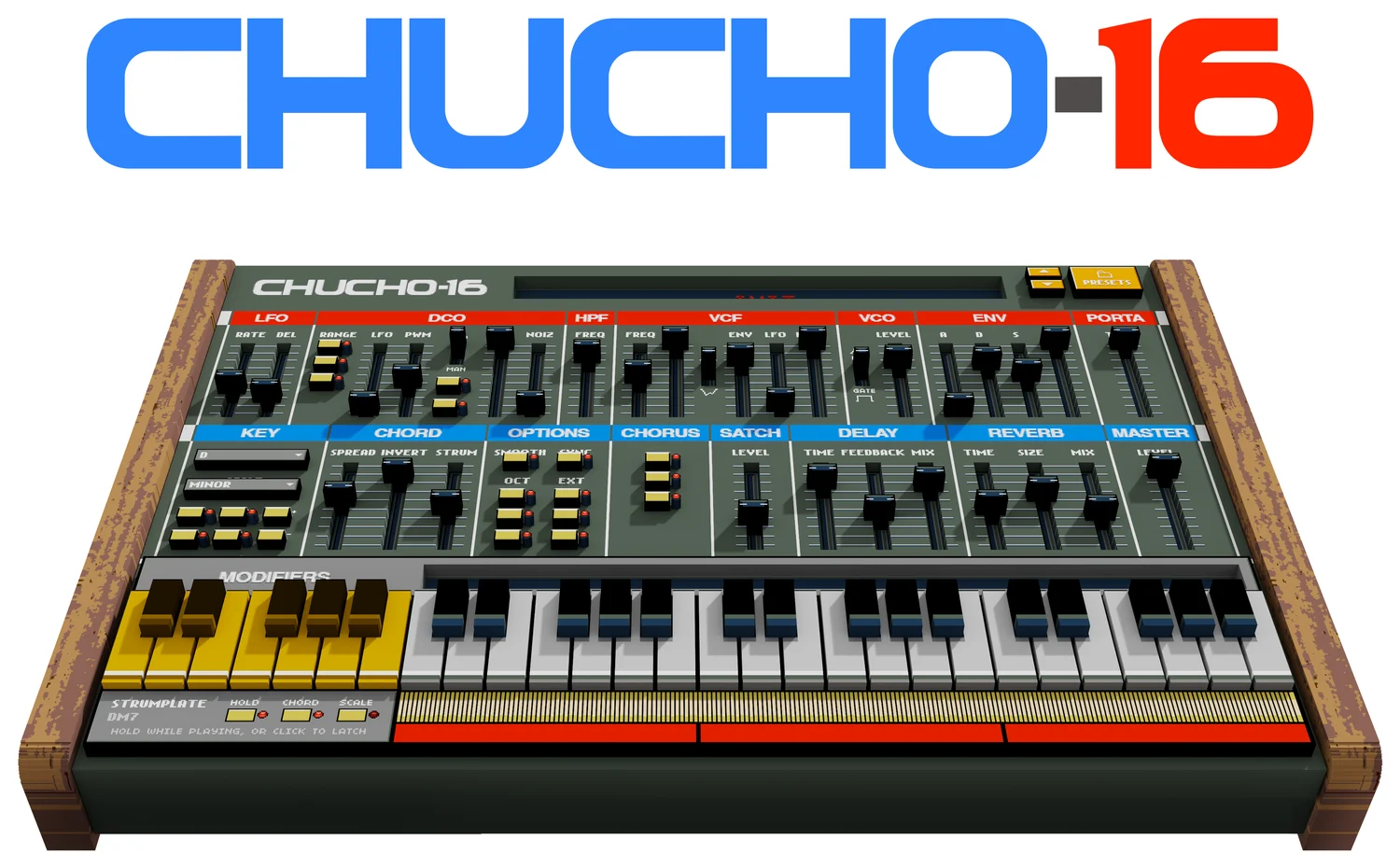
CHUCHO-16 is two instruments wearing one faceplate. Underneath: a six-voice model of a Roland Juno-106, built not from schematics but from a week of measurements of a real, working unit - every fader captured, sliced and fitted, so the stepped envelopes, the collapsing pulse, the self-oscillating filter and the slow thermal wander behave like the hardware they came from. On top: a chord machine. Play one key and a voiced chord in your chosen key and scale comes out - shaped by a modifier octave, spread and inversion, a fixed-register smooth mode for automatic voice leading, a tempo-synced strum, and an arpeggiator.
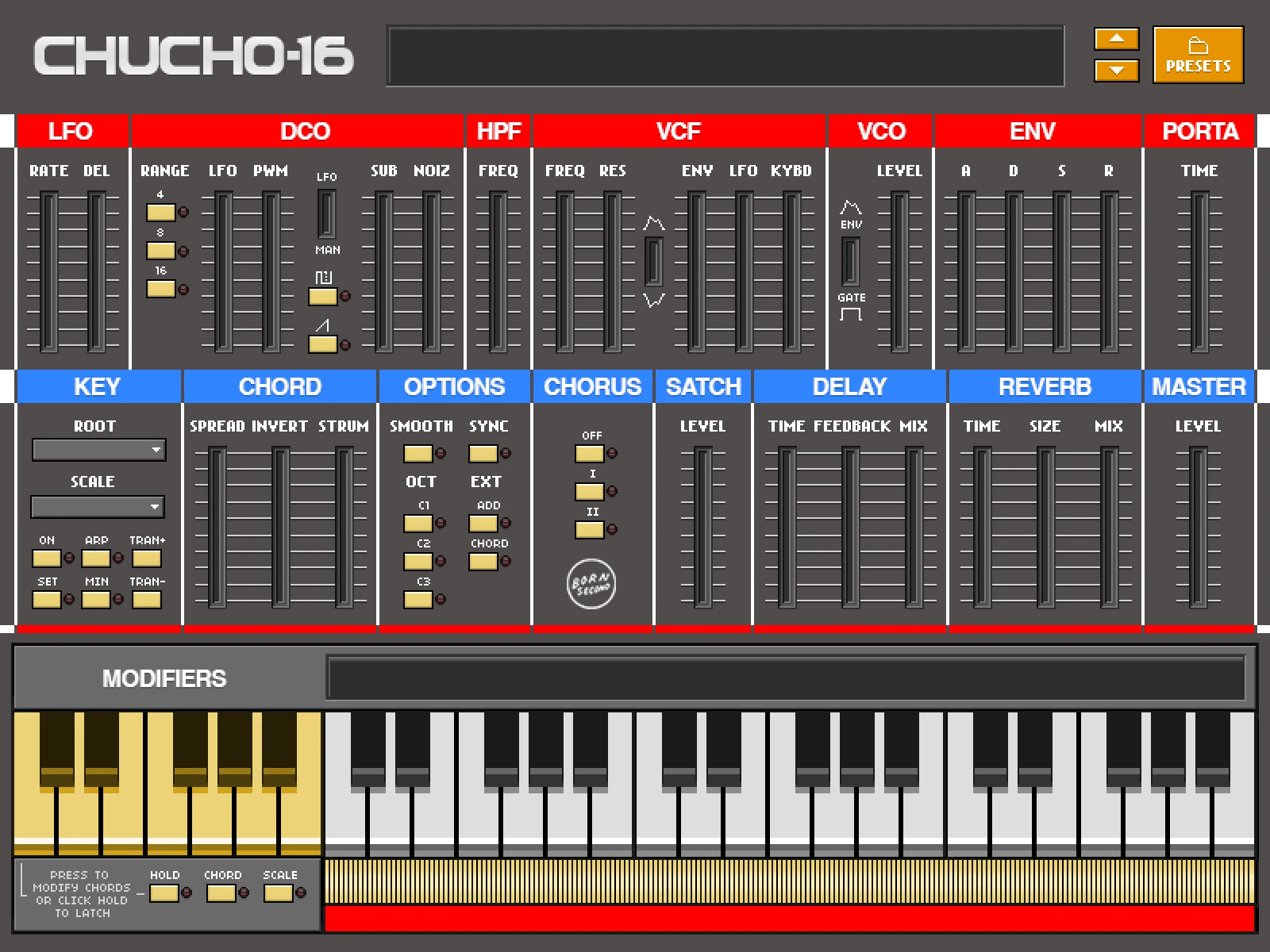
See it played
Demo video coming shortly - join the mailing list below and we'll send it over.
The chord machine · harmonise the key, one degree at a time
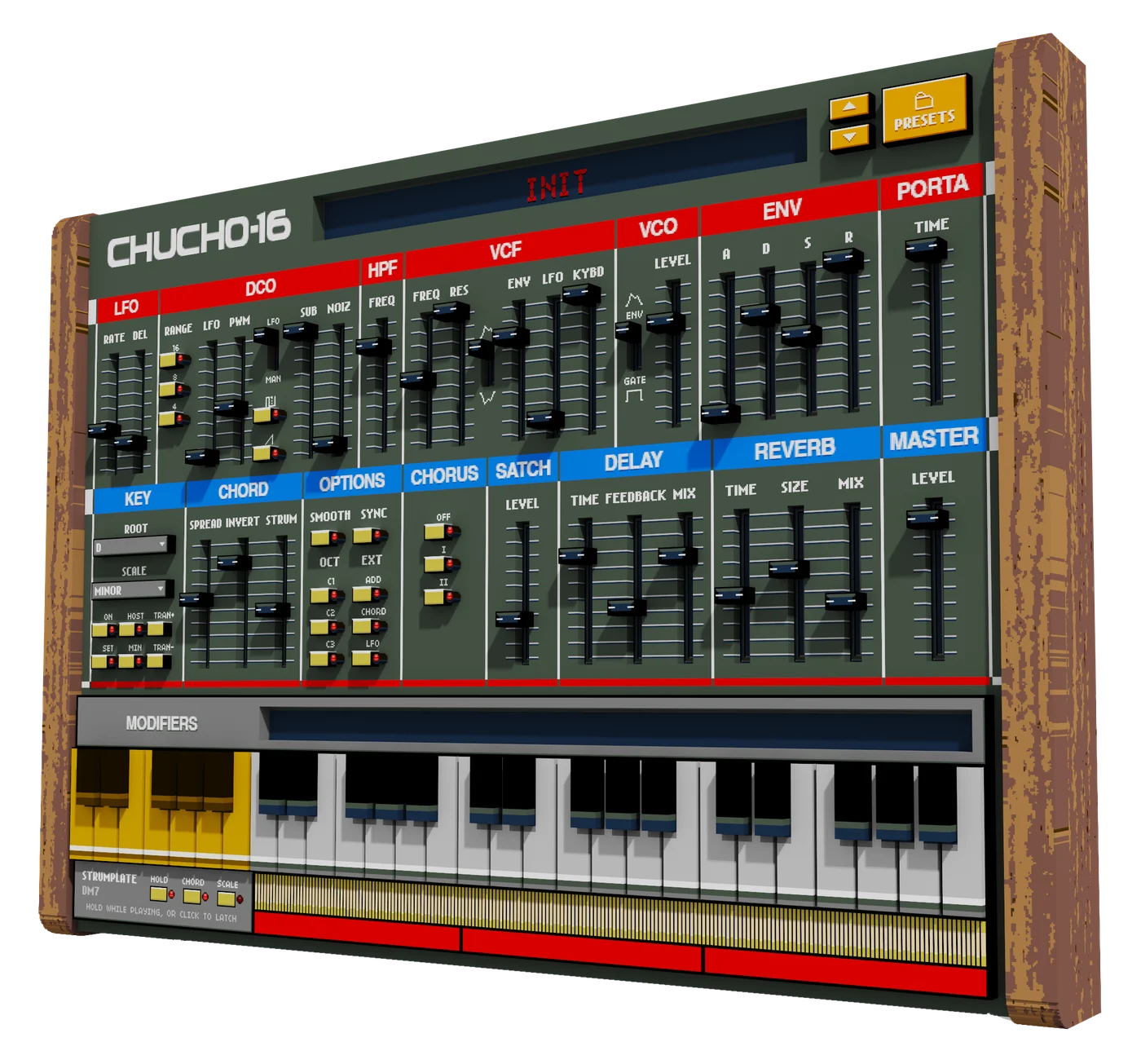
- MODIFIER OCTAVE - twelve labelled keys reshape the chord: BASS · 6 · 7 · 11 · 9 · MAJ · SUS2 · MIN · M7B5 · SUS4 · 5 · DIM, with secret combos (MAJ+SUS4 = aug, MAJ+MIN+7 = the Hendrix 7#9).
- KEY MEMORY - flip HOLD and latches are remembered per root: every key keeps its own chord assignment. You're not filtering every chord - you're arranging the key.
- SMOOTH - folds every chord into one register so progressions voice-lead themselves.
- STRUM & ARP - tempo-synced strums from 1/128 to 1/8 per note, or an up-down arpeggiator over everything you're holding.
- STRUMPLATE - a twelve-zone ribbon under the keys holding the current chord or scale, in the proud one-finger tradition of the Omnichord. Drag it like a real instrument.
- FULL MIDI EXPORT - everything performed comes out of the MIDI port: chords with strum timing, retunes, arp patterns. Record the arrangement as notes.
Measured, not imagined
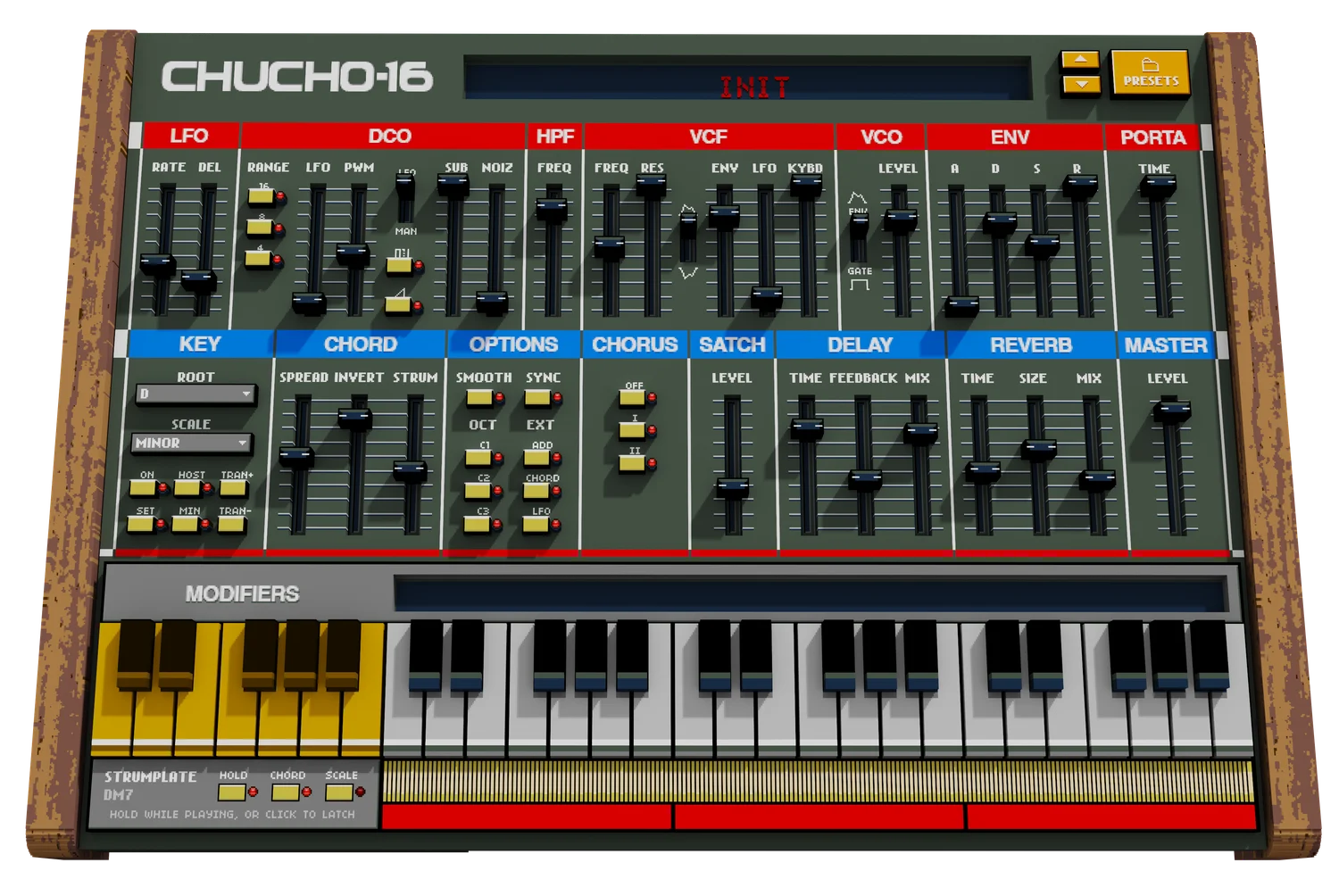
The synth engine keeps the fingerprints of the specific, slightly cantankerous 106 it was measured from: envelopes stepping at 240 Hz, six genuinely different voices with the unit's own filter offsets, one shared noise source so chords breathe together, the PWM fader that chokes the pulse silent at the top, a VCA that never fully sleeps, and the bass-boost secret hiding in HPF position 0. Chorus I/II comes from the anti-phase BBD pair on the board - the on switch for "sounds expensive."
299 presets included
Chucho Factory - the Born Second patches plus 165 conversions from classic Juno-106 banks - and the complete original 106 Factory set, all 128 by name, converted byte-for-byte from real hardware sysex and loudness-matched. Presets change the sound; your key, voicings and performance settings stay put.
Get Info
| Kind | Software instrument - six-voice chord synthesizer |
| Engine | Measured Juno-106 model · ZDF ladder filter · BBD chorus I/II · Satch, delay, reverb |
| Chord machine | 9 scales · 12 modifiers with per-root memory · smooth voice leading · synced strum · arpeggiator · strumplate · chord MIDI out |
| Formats | VST3, AU, Standalone - 64-bit (macOS & Windows) |
| System | macOS 11+ (Intel & Apple Silicon) · Windows 10+ |
| License | $25 one-time · 5 activations · unlimited updates · no dongle |
| Demo | Free, fully functional with a periodic gentle noise swell |
Vintage hardware referenced on this page is identified for describing sound character and heritage only; Born Second is not affiliated with, sponsored by, or endorsed by Roland Corporation or Suzuki Musical Instrument Corporation. Juno and Omnichord are trademarks of their respective owners. All trademarks are property of their respective owners. VST is a trademark of Steinberg Media Technologies GmbH.
Downloads
Manuals
User Manual (PDF)Mailing list

Join the mailing list?
New instruments, Squimpler sample packs, and preset drops. A few emails a year - we're busy soldering.